
Movement in the equity market this week will be guided by a host of macroeconomic data announcements, global trends and trading activity of foreign investors, analysts said. Stocks markets concluded the last week on a subdued note, as investors grappled with global uncertainties.
Provided talks on the matter are fruitful, the dividend payout will made during the current RBI financial year ending June 30, 2018.

Finance Minister Nirmala Sitharman on Monday held a performance review meeting with heads of public sector banks and asked them to make concerted efforts to garner deposits. Deposits have been growing 300-400 basis points lower than the credit growth in the last few months, creating an asset-liability mismatch for banks. During deliberations on the deposit mobilisation, she said that while the credit growth has picked up, mobilisation of deposits could further be improved to fund the credit growth sustainably, and asked banks to make concerted efforts to garner deposits by conducting special drives.

Better protection for depositors and investors was one of the chief considerations in Union Finance Minister Nirmala Sitharaman introducing, on Friday, the Banking Laws (Amendment) Bill, 2024, in the Lok Sabha to amend four pieces of legislation. This amendment is also to improve audit quality in public-sector banks (PSBs), offer consistency in reporting by banks to the Reserve Bank of India (RBI), and provide for an increase in the tenure of directors in cooperative banks.

'Self-declaration from the customer in case of no change in KYC information or change only in the address details may be obtained.'

What is currently perceived as a massive, low-tech liability could become a high-value, export-oriented economic engine, points out Ajit Balakrishnan.

Reserve Bank of India (RBI) on Friday said its board has approved a dividend payment of Rs 30,307 crore to the government for the financial ended March 2022. The board approved the transfer of Rs 30,307 crore as surplus to the central government for the accounting year 2021-22 while deciding to maintain the Contingency Risk Buffer at 5.50 per cent, RBI said in a statement. The decision on the dividend payment was made in the 596th meeting of the Central Board of Directors of RBI, headed by Governor Shaktikanta Das, held on Friday.

In response to the panic triggered by Trump's trade policies, the RBI net sold approximately $43 billion in the second half of FY25 to curb volatility, as the rupee plunged to a low of 87.95 per dollar in February this year.

Who else will take on the might of Microsoft, Google, and Amazon if not the Adanis, Ambanis, Birlas, or Tatas?, asks R Jagannathan.

The weakening of inflation, prospects of economic growth, geopolitical uncertainty and comfortable system liquidity may result in the Reserve Bank of India's (RBI) Monetary Policy Committee (MPC) to cut the repo rate by another 25 basis points, opine top economists. They also said the external economic pressures like trade policies and others would require continued RBI's accommodative stance and policy support for the Indian industry to sustain the growth.
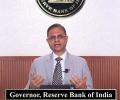
'India has the potential to grow at more than 7%, with the monetary policy providing a supportive hand.'

A family feud within the politically influential Matua community has erupted between Union minister Shantanu Thakur and his brother, BJP MLA Subrata Thakur, creating ripples in West Bengal's political landscape and posing a challenge for the BJP ahead of upcoming elections.

P K Mishra, a retired IAS officer of the Gujarat cadre, is currently serving as the principal secretary to the prime minister.

Tata Sons Private Limited, the holding company of the Tata group, witnessed a precipitous drop in its net debt to Rs 5,656 crore in the 10 months ended January this year, as its cash reserves burgeoned to Rs 9,516 crore during this period. Eight years ago, in 2015-16, Tata Sons reported a net debt of Rs 5,132 crore; from March 2017 until March 2023, this figure was above the Rs 14,700 mark, peaking at Rs 27,437 crore at the end of March 2019, according to data sourced from Capitaline. The company's gross debt nearly halved to Rs 15,173 crore until January 2024 on a standalone basis, down from a peak of Rs 31,363 crore reported in the financial year ended March 2019.
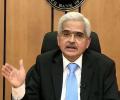
Reserve Bank Governor Shaktikanta Das on Tuesday said the fiscal-monetary coordination was at its best during the last six years even as he thanked Prime Minister Narendra Modi for giving the opportunity to head the monetary authority of the country. Das, in a series of posts on X, on his last day of his six-year term as RBI Governor, also thanked the Finance Minister, various stakeholders and his colleagues at the central bank.

'I don't know when I will be able to access those funds.'


Moody's Ratings on Tuesday projected general government debt to stabilise above 80 per cent of GDP over the next three years, down from 89.3 per cent in 2020-21. "General government interest payments to fall to around 24 per cent of general government revenue over the next two years from over 28 per cent in fiscal 2020-21, although this remains much higher than the median 8.7 per cent recorded by Baa-rated peers," Moody's Ratings associate managing director Gene Fang said in a post-Budget reaction.

Tata Consultancy Services (TCS), the group's biggest cash generator, overtook Vedanta to become the highest dividend payer in India in FY23. The IT services major paid Rs 42,090 crore for FY23, up 167.4 per cent from Rs 15,738 crore for FY22. The 10 biggest payers together shelled out Rs 2.06 trillion for FY23, more than double the Rs 98,371 crore for FY22.
The board of Zee Telefilms Ltd has recommended 55 per cent dividend for the financial year 2002-03 involving a total payout of about Rs 23 crore (Rs 230 million).

From the Sensex pack, IndusInd Bank, NTPC, Asian Paints, Hindustan Unilever, JSW Steel, Tech Mahindra, Bajaj Finance, Infosys, Wipro, ICICI Bank, Bajaj Finserv, HDFC Bank and Tata Motors were among the major laggards. HCL Technologies, Power Grid, Titan, Reliance Industries, UltraTech Cement, Tata Steel, State Bank of India and Mahindra & Mahindra were the gainers.

'The increase in the limit for TDS on interest to Rs 1 lakh will ensure greater cash flow in the hands of senior citizens.'

This amount will include Rs 13,100 crore that Economic Affairs Secretary Subhash Garg has been publicly seeking from the central bank's contingency reserve fund since 2017-18 (FY18).

The approval will, however, be subject to the regular conditions on valuation and pricing norms laid down by the Reserve Bank of India.

Vedanta Limited (Vedanta) helping its parent and group holding company Vedanta Resources to deleverage its balance sheet has started to strain its balance sheet. Vedanta's gross debt (consolidated) was up 24.3 per cent year-on-year (YoY) in FY23 and reached a six-year high of Rs 66,628 crore by the end of March. Similarly, its net debt went up 20.3 per cent YoY to Rs 45,706 crore at the end of FY23, up from Rs 38,228 crore a year ago; it was the highest since FY20.

The Reserve Bank of India (RBI) booked massive gains on its foreign currency sales and needed to provide much lesser for its reserves in 2020-21 (FY21), helping it to carve out a significant Rs 99,122-crore dividend for the government, revealed the RBI's annual report for FY21. By doing so, the central bank's risk buffers have reduced to the bare minimum, which may restrict some of RBI's scale of operations, and would likely hamper dividend payout for financial year 2021-22, said analysts. The annual accounts are for nine months ended March 31, 2021 since the RBI changed its accounting year from July-June to April-March from FY21.

The Malegam committee on the RBI's capital adequacy had suggested that the RBI must move away from its methodology to calculate the foreign exchange gains to a weighted average cost-based valuation method. Central bank may done away with provisioning requirements, to enable higher transfer of surplus in the 2017-18 fiscal, analysts say.

In the last fiscal, the government had originally budgeted a dividend income of Rs 27,178 crore (Rs 271.78 billion) from PSUs.

This demand comes at a time when the government is falling short of its revenue targets due to dwindling tax and low disinvestment receipts. It could account for the dividend in the upcoming Union Budget on February 1. RBI is, however, yet to take a final call on the government's demand and might decide on this at its central board meeting scheduled for February 15 in New Delhi.

Reserve Bank of India (RBI) is unlikely to cut the benchmark interest rate at its upcoming monetary policy review meeting, taking place soon after the announcement of the Lok Sabha election results, amid inflation challenges, said experts. The Monetary Policy Committee (MPC) may also refrain from rate cut as economic growth is picking up, notwithstanding the elevated interest rate of 6.5 per cent (repo) prevailing since February 2023. The meeting of the Reserve Bank Governor Shaktikanta Das headed MPC is scheduled for June 5 to 7.

Rising oil prices and diminishing cash pile to limit capacity in 2018-19

In order to further enhance customer convenience, and to leverage the 24x7 availability of real-time gross settlement (RTGS), NACH which is currently available on bank working days, is proposed to be made available on all days of the week effective from August 1, 2021, RBI's Shaktikanta Das said.

The RBI under former governor Shaktikanta Das resisted pressures to cut interest rates through 2024 as it kept its 'Arjuna's eye' trained on inflation, but the central bank under a new detail-oriented head will soon have to take a call if it can continue sacrificing growth. Das, a career bureaucrat who in 2016 oversaw Prime Minister Narendra Modi's highly disruptive demonetisation move, left a lasting legacy as he demitted office towards the end of 2024 after expertly navigating monetary policy for six years, the highlight of which was steering India's recovery through the pandemic.

The interim dividend will help Narendra Modi-led government partly bridge the deficit its budget had developed after the announcement of a Rs 75,000 crore a year cash dole scheme for small farmers.
RBI Governor Shaktikanta Das has assured Finance Minister Nirmala Sitharaman that the Rs 12.05-trillion gross borrowing programme for FY22 will go through smoothly.

The Reserve Bank (RBI) resisted a 'raid' planned by some in the government to extract Rs 2-3 lakh crore from its balance sheet in 2018 to meet populist spending in run-up to general elections, Viral Acharya, who was deputy governor at RBI at that time, has written.

Shaktikanta Das will demit the office on Tuesday after completing six years as the 25th Governor of the Reserve Bank of India. Revenue Secretary Sanjay Malhotra will replace him as the 26th Governor. He was appointed as the Governor on December 12, 2018, after the abrupt exit of Urjit Patel.

While this will incur a revenue loss amounting to 0.2 per cent of GDP, it will provide a strong boost to consumer sentiment and spending, points out Rajani Sinha.

Rs 135.3 crore. How much of it was salary, and how much commission?

"The new structure will substantially reduce taxes on the middle class and leave more money in their hands, boosting household consumption, savings and investment," Sitharaman said presenting what was dubbed as 'reformist' budget for the next fiscal in Lok Sabha.
